Sewer Line Repair & Camera Inspection in Illinois
Underground sewer lateral failures can cause severe property damage, foul odors, and repeated basement sewage backups. Connect with licensed Illinois sewer professionals equipped with high-resolution in-line inspection cameras and trenchless restoration technology.
Don't guess what lies beneath your lawn or driveway. Modern diagnostic cameras eliminate costly trial-and-error by pinpointing root intrusion, cracked clay pipe, or sagging sewer bellies before any ground is broken.
Why Sewer Lateral Pipes Fail in Illinois
The main sewer lateral is the underground pipe that carries all wastewater from your home's toilets, sinks, tubs, and washing machines out to the municipal sewer main in the street or alley. Across Illinois, homes built prior to the 1980s commonly feature vitrified clay tile, cast iron, or bituminous fiber (Orangeburg) piping.
These older materials face several regional challenges:
- Severe Freeze-Thaw Shifts: Deep winter freezing and spring thaws cause soil expansion and subsidence, shearing rigid clay joints and creating pipe misalignments.
- Aggressive Tree Root Systems: Fast-growing trees like maples, oaks, and willows send fibrous root systems through tiny hub mortar joints in search of warm wastewater, gradually shattering the pipe walls.
- Cast Iron Channel Rot: Decades of acidic wastewater slowly corrodes the bottom trough of cast iron pipe until the floor of the pipe completely dissolves into the surrounding soil.
- Pipe Bellies (Sagging): Shifting ground causes a section of pipe to dip lower than the rest of the run, creating a perpetual pool of standing water that catches solid waste and toilet paper.
Signs You Need an Immediate Sewer Inspection
If waste is backing up into low-lying floor drains, if you notice soggy foul-smelling patches in your yard, or if a gurgling sound echoes through plumbing vents whenever a toilet flushes, your main lateral is severely obstructed. Call dispatch at (217) 216-8586 to arrange an in-line camera evaluation.
How In-Line Camera Inspection Works
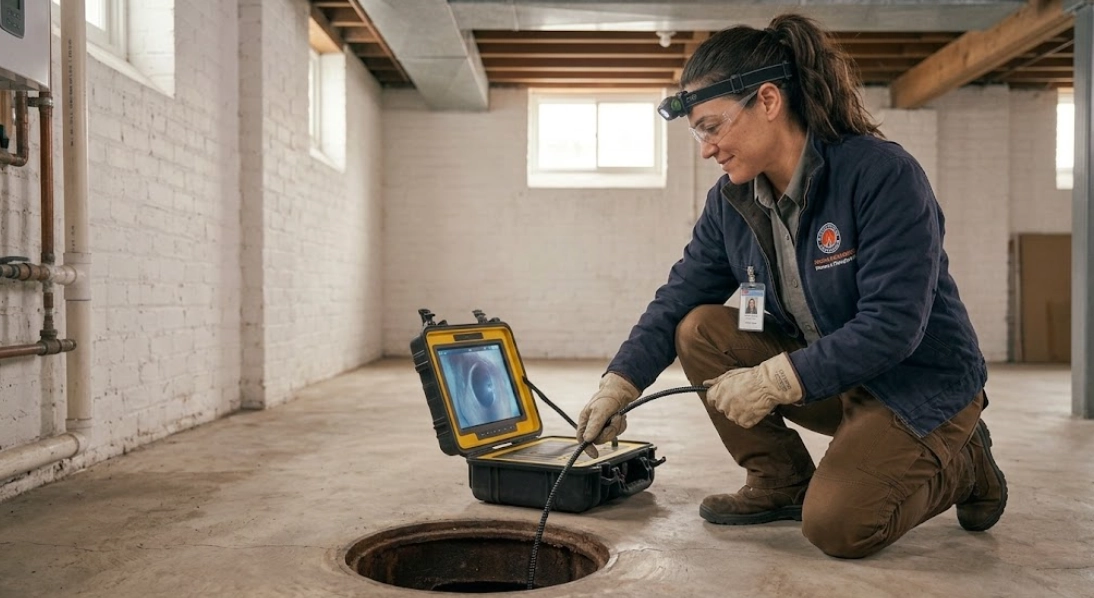
Professional sewer diagnostics rely on fiber-optic camera systems mounted on flexible push-rods. As the camera travels down the cleanout, high-output LED lights illuminate the entire pipe bore, and an integrated digital transmitter (sonde) emits a radio frequency:
- Visual Clarity: The technician views real-time high-definition video on a portable monitor, identifying whether the issue is simple root blockage, grease buildup, or structural collapse.
- Precise Above-Ground Locating: The technician uses a handheld locator wand above ground to pinpoint the exact surface location and depth (in feet and inches) of the problem spot, preventing unnecessary trenching through landscaping or driveways.
Repair Options: Traditional vs. Trenchless Solutions
Depending on what the camera reveals, your contractor will outline the most cost-effective repair method:
- Trenchless Cured-In-Place Pipe (CIPP) Lining: If the pipe structure is intact but suffering from root intrusion or cracks, an epoxy-saturated fiberglass sleeve is inverted through the pipe and cured in place, creating a jointless, root-proof "pipe-within-a-pipe" that lasts for decades without digging up your yard.
- Trenchless Pipe Bursting: A hardened conical bursting head is pulled through the old damaged line, shattering it outward while simultaneously pulling a new, seamless High-Density Polyethylene (HDPE) pipe into its place.
- Targeted Spot Excavation: When a pipe has completely collapsed in a single localized area, an excavation crew digs a small, targeted trench to cut out the broken section and splice in durable PVC schedule 40 pipe with heavy-duty shielded mechanical couplings.
Understanding Cost Factors
Sewer repairs vary widely based on several site-specific variables:
- Depth and Soil Conditions: Excavating at 4 feet requires significantly less heavy machinery and shoring than digging 10 feet down through saturated clay soil.
- Surface Restorations: Repairing pipe beneath open lawn is faster and less costly than cutting through concrete driveways, stone patios, or asphalt public roadways.
- Municipal Permitting & Right-of-Way: If the repair extends into the street easement, municipal traffic control, bonding, and inspection permits may apply.
Frequently Asked Questions
What does a sewer camera inspection show?
A sewer camera inspection provides live high-definition color video of the inside of your underground sewer lateral pipe. It pinpoints the exact footage and depth of tree root blockages, cracked or collapsed pipe segments, standing water bellies, offset joints, and grease accumulation.
What is the difference between traditional excavation and trenchless sewer repair?
Traditional excavation requires digging an open trench along your yard, driveway, or street to physically remove and replace broken pipe sections. Trenchless sewer repair (such as Cured-In-Place Pipe lining or pipe bursting) requires only small access pits, pulling an epoxy-saturated resin liner through the existing pipe to create a seamless, root-proof pipe within the old one with minimal landscape destruction.
Who is responsible for the sewer line between my house and the street in Illinois?
In almost all Illinois municipalities, the property owner is legally and financially responsible for the private sewer lateral from the building foundation all the way to the connection at the municipal main in the street or alley right-of-way.
What factors influence the cost of sewer line repairs?
Key factors include the depth of the pipe (deep Illinois frost lines often require 6 to 10 foot excavation), the length of pipe needing replacement, surface restorations required (grass vs. concrete driveway vs. asphalt street pavement), municipal street-opening permits, and whether trenchless lining is structurally viable.
Related Services
Drain Cleaning & Clogs • Water Leak Detection • Sump Pump & Flood Defense • Emergency Plumbing
Schedule a Sewer Camera Inspection in Illinois
Connect with an experienced local sewer specialist to inspect, clean, or repair your underground lines.